Turning a Trading Book Chapter into a Testable Exercise
Read definitions critically, extract a rule and track missing implementation details without pretending the book or reviewer established a trading edge.
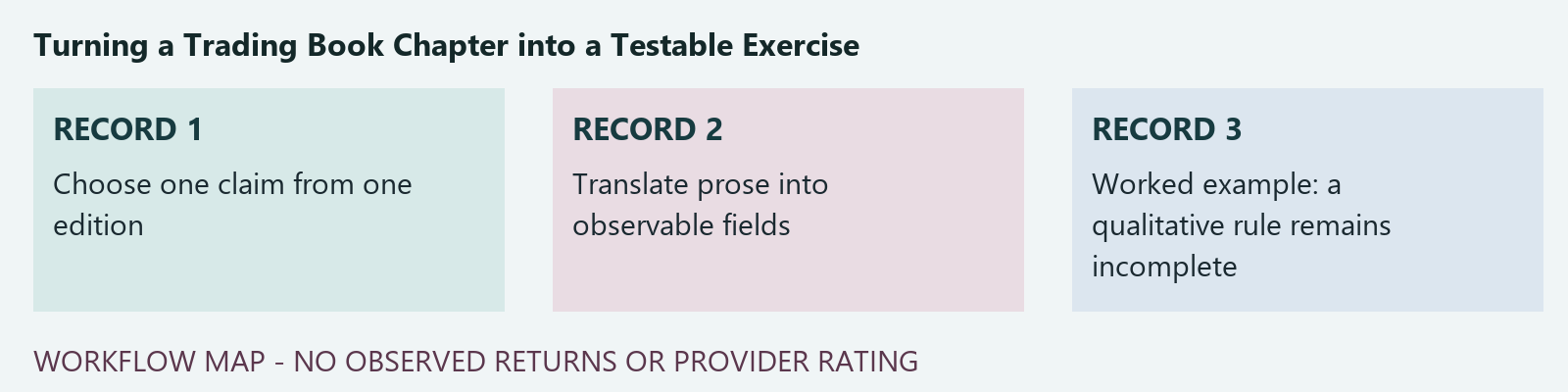
Choose one claim from one edition
Record title, author, edition, chapter and page reference before extracting a method. A later edition or interview can change the explanation. Separate conceptual argument, anecdote and explicit rule. Do not turn an author's personal experience into a universal result. A catalogue note based on publisher information is also different from a first-hand reading assessment. This chapter does not claim the publication read every book in its directory or reproduced any author's private trading history.
Translate prose into observable fields
Identify instrument, information source, decision time, entry condition, exit condition and required account constraints. A phrase such as buy weakness or follow strength needs a defined reference and observation window before it becomes reproducible. Mark missing rules instead of filling them with familiar indicators. If you create an interpretation, label it as your version rather than the author's tested system. Source provenance matters because a polished checklist can otherwise imply more precision than the original text actually supplied.
Worked example: a qualitative rule remains incomplete
Invent a fictional passage proposing purchase after an unusually large decline. A learner must still define large relative to what, which historical window is available, when the condition is evaluated and what ends the position. Choosing a ten-observation reference and a fixed threshold produces a new exercise specification, not proof that the author endorsed those choices. Retain the missing-field list and the chosen interpretation. Do not search many thresholds, publish the best historical return and attribute that selected result to the book.
Separate learning from performance research
A replay can teach rule interpretation without establishing investment value. Begin with a small invented fixture that tests whether two readers reach the same decision from the same inputs. For an empirical study, use dated data, causal transformations, declared costs and a recorded selection process. Time-aware evaluation documentation helps define mechanics but does not supply a complete financial research design. Keep software debugging, parameter selection and independent evaluation as distinct stages so a teaching exercise is not presented as validated strategy evidence.
Check risk and execution assumptions
A prose target or stop does not guarantee an account fill. SEC order references are useful when converting an execution discussion into a question about price and fill uncertainty. Instrument units, financing, liquidity and account eligibility must be supplied separately. Avoid treating a book's historical market context as current broker terms. If an example omits position sizing or adverse paths, write those omissions next to the lesson rather than silently constructing a risk policy and calling it the author's complete approach.
Write a bounded reading conclusion
Describe what concept became clearer, which implementation fields remain absent and what further evidence would be required. A useful conclusion can be that a chapter explains a mechanism well but does not provide an executable system. Keep quotations brief and attributed; the worksheet is for your own extracted rules, not redistributing a chapter. The outcome of this exercise is a transparent learning record. It is not a book ranking derived from invented reading hours, completed backtests, interviews or student-performance statistics.
Decision record
| Question | Record to retain | Decision boundary |
|---|---|---|
| Text identity | Edition, chapter and exact reference | Different versions may teach different rules |
| Extraction | Supplied fields and separately labelled interpretation | A reader-created threshold is not the author's result |
| Exercise | Inputs, expected decisions and ambiguity notes | Learning correctness is not investment validation |
| Conclusion | Concept learned, omissions and next evidence request | Do not imply first-hand reading or replication without it |
Blank working record
The worksheet contains column headings only. Enter your own dated observations, keep absent evidence marked unknown, and do not treat the file as certification.
 Download worksheet (CSV)
Primary references
- scikit-learn: cross-validation and temporal data
- SEC: order types and execution limitations
- CME: education catalogue
These documents support mechanisms and source definitions, not a tested trading result or a recommendation. Accessed 9 October 2026. The decision workflow and invented examples above are editorial exercises.
Keep reading
Publication methodology | Working glossary | Source and correction policy
Record attribution before adding execution detail
The study journal now keeps selected format, actual-access declaration, source location and reader interpretation apart. Completing those fields does not authenticate an inspected passage or full-text rights. The authored causal-definition dossier has actual data and independent master absent, even with every written field filled. A sample can support a bounded question while the reader's threshold remains their own addition. The final learning output should state the next real artifact rather than convert a software pass into financial success or a fabricated author-endorsed method.