Japanese Candlestick Charting Techniques: geometry before prediction
Use Nison to organise candle terminology, then define geometry, context and observation timing without assuming pattern profitability.
Editorial reading notes and source-based resource assessments, not a claimed cover-to-cover reviewer programme. Edition, access and evidence limits are stated.
Identify the book and its narrower purpose
The publisher identifies Steve Nison's Japanese Candlestick Charting Techniques and describes its candlestick subject matter. That establishes a title-level starting point, not a completed full-edition assessment by this desk. Match an actual edition and passage before attributing a specific pattern threshold or interpretation to the author.
A useful learning objective is to describe a candle unambiguously and compare that definition with what a charting platform displays. The reference can organise terminology without supplying a complete trading strategy for every named formation. Reader outcomes, signal accuracy and profitable application are separate questions requiring evidence that is not supplied by a catalogue description.
Work the candle geometry explicitly
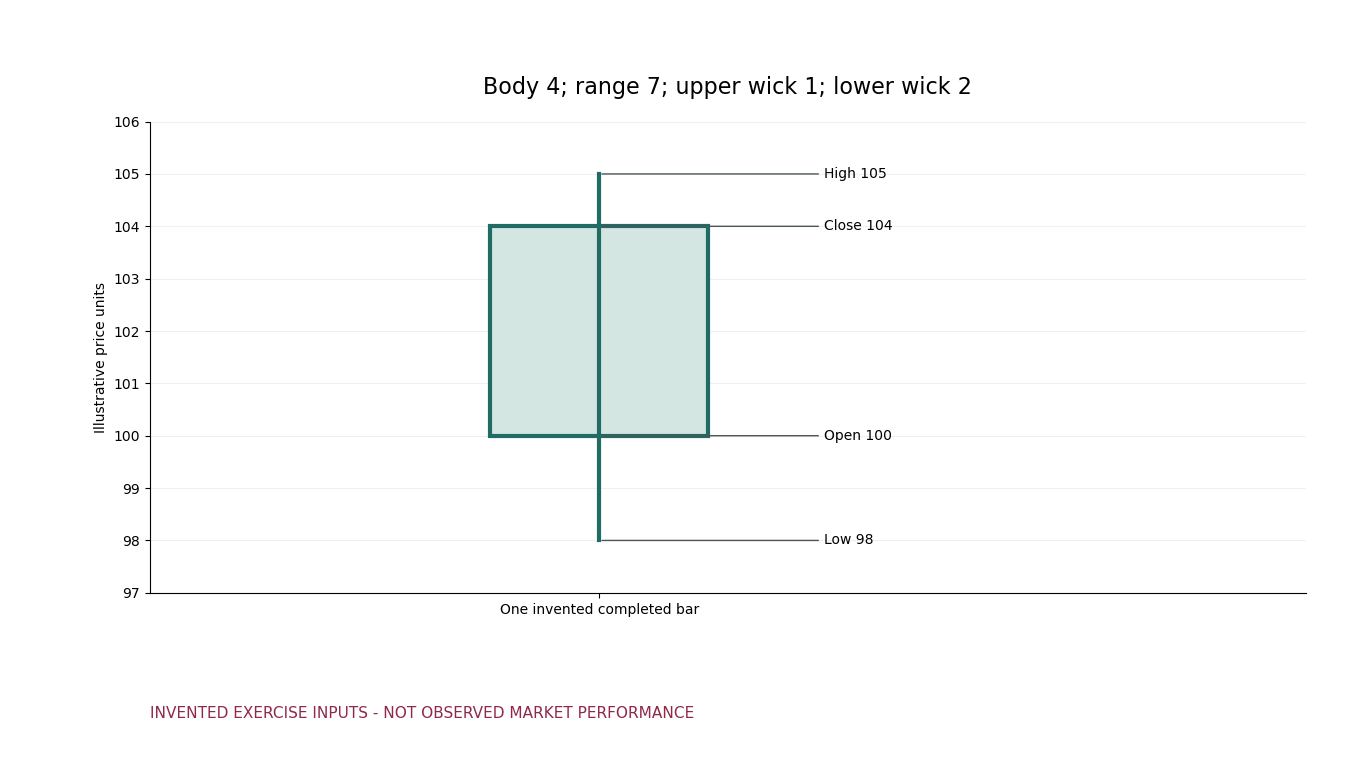
For an invented bar with open 100, high 105, low 98 and close 104, the absolute body is four units and the high-low range is seven. The upper wick is one unit, from 104 to 105; the lower wick is two, from 98 to 100. Check that high is at least both open and close and low is at most both.
This is an original arithmetic exercise, not a candle reproduced from the book or a live market. A descriptive bullish body does not establish the next price direction. A zero-range bar also needs a declared handling rule before forming ratios. Record every geometric definition before assigning a memorable pattern name.
Context is another hypothesis, not a hidden adjective
Words such as long wick, small body and strong prior trend require quantitative definitions if the idea is to be tested. Specify the reference scale, lookback and threshold before viewing the later outcome. A body can be small relative to its own range but large relative to recent bars; those are different observations.
Ask a second reader or deterministic implementation to label the same invented bars from your specification. Disagreements locate missing rules, not proof that either person has discovered an edge. Keep any contextual trend filter distinct from the candle geometry so its contribution and information window remain inspectable.
The final candle was not known while it formed
A completed bar fixes its closing price only at the declared completion boundary. An intrabar shape can change before then. Preserve the chart interval, timezone, session rule and the earliest time the completed observation was available. A later screenshot does not reconstruct all the shapes visible during the bar.
Define the first permissible order and the invalidation or expiry policy separately from the label. If a pattern requires a following confirmation bar, that bar delays the information boundary. Do not grant an earlier fill merely because the final multi-bar image looks persuasive. Price adjustment and missing observations need explicit treatment too.
Compare incremental information under common conditions
An evaluation could compare the defined pattern with an unconditional or simpler baseline using the same universe, dates, costs and exposure. Specify the outcome horizon and exit convention before evaluating many names or thresholds. A pattern frequency and a monetary strategy return are not equivalent statistics.
Keep the search history and the full eligible population, including labelled cases with unfavourable outcomes. Selected textbook charts are learning examples, not a representative market sample. If the observations needed for an independent test are unavailable, keep the work as a definition exercise rather than publish an invented success percentage.
Use the reading output for clearer questions
The worksheet records the inspected passage, your geometry, contextual assumptions, clock and proposed test. Murphy's broader technical-analysis reference is a task-specific alternative when the gap is terminology across several indicator families rather than candle definitions alone. Neither title automatically validates a combined strategy assembled from its labels.
No full-book reading history, market study or numerical rank is claimed by this companion. The benefit is a reproducible description another reader can check, followed by explicit unresolved economic questions. An accurate diagram can clarify what a pattern means while leaving its forecasting value entirely unestablished.
Reading decision checkpoints
| Question | Useful output | Do not infer |
|---|---|---|
| Geometry | OHLC, body, range and wick definitions | A named shape treated as prediction |
| Context | Predeclared scale and trend rule | Adjectives chosen after the outcome |
| Timing | Completed bars and confirmation boundary | Final candle assigned to earlier decisions |
 Download blank reading record (CSV)
Headers only. No completed reading sessions or reader outcomes are supplied.
Sources and scope
Choose a book by the skill you need
Label agreement precedes an outcome claim
Two readers can disagree on a pattern when body, shadow, equality and context thresholds are unspecified. Preserve both definitions before choosing the one with attractive hindsight. The new pattern-translation guide uses authored geometry and explicit reader-added rules; it does not attribute uninspected thresholds to Nison or claim independent predictive evidence. A correctly calculated candle body is not a validated entry, native exit or broker fill. Actual instrument evaluation still requires the authoritative full process and independent master.